Probably Fine Luxembourg
Information
This page collects sources of information that may be useful to parents, students, teachers and researchers seeking to understand the Luxembourg education system.
The focus is on information relevant to educational quality, student wellbeing, governance and accountability.
System-Level Sources
National Education Report (Bildungsbericht)
The National Education Report is the most comprehensive periodic review of the Luxembourg education system, usually available in both French and German.
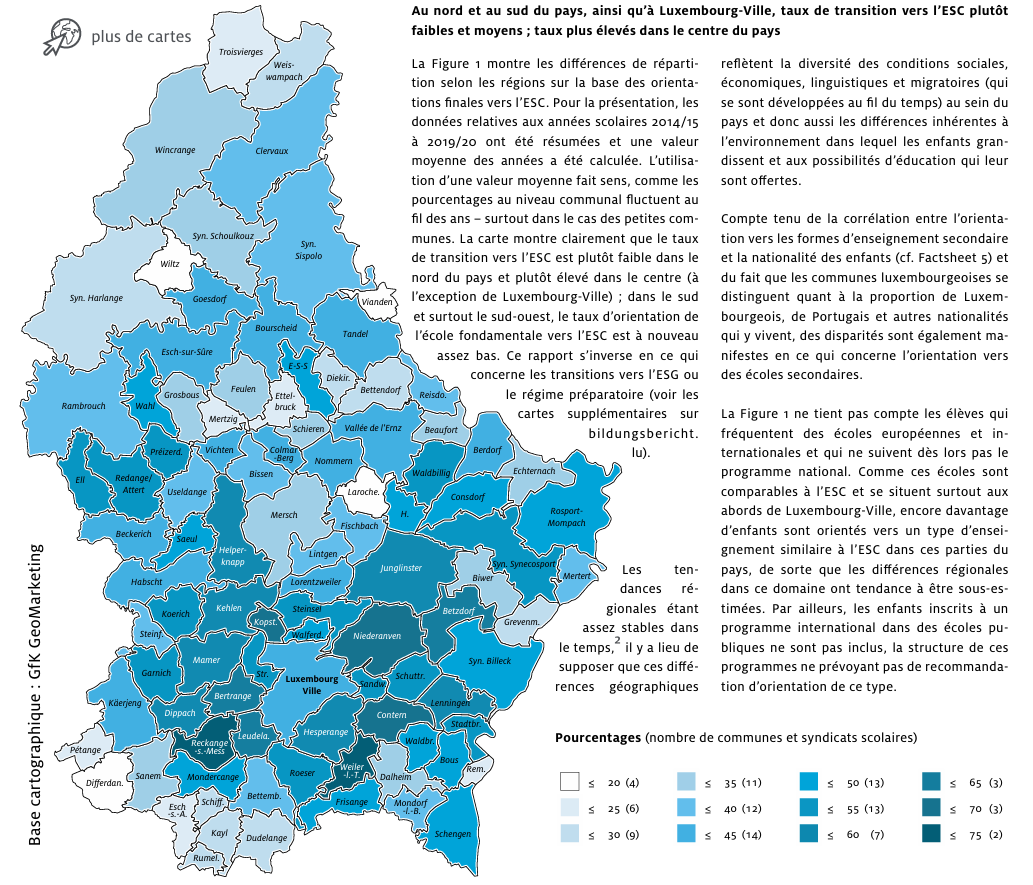
These reports discuss educational outcomes, inclusion, wellbeing, school pathways and system performance at a national level. There is very little per-commune information, and none at all referring directly to individual schools. The most granular information available to parents choosing a school is the map of per-commune referral rates from general primary school to academic track at post-11. This is not intended by the ministry as a proxy for educational quality, but if an academic education is desired then consulting this map before selecting the commune of enrollment would seem to make sense. The map correlates somewhat to house prices, and to socioeconomic stratification generally, but not exactly.
 .
.
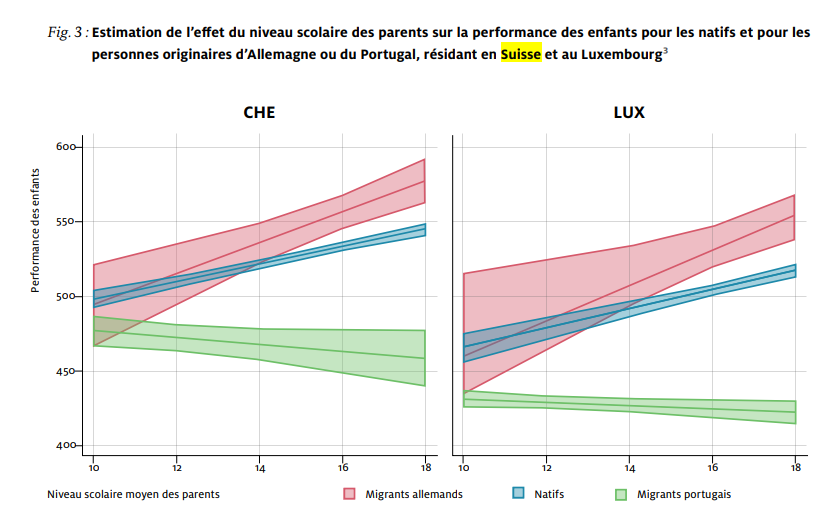
Another key question that parents have is “will my child be treated with dignity, or discriminated against”. This is a tense question, and thankfully incidences of overt and intentional discrimination in the teaching profession are rare, and subject to sanction. The key graph comes again from the bildungsbericht:
 .
.
The x-axis of the graph shows the level of education of the parents, the y-axis shows the attainment of the child if educated in Switzerland (left) or Luxembourg (right). Leaving aside the global shift downwards for Luxembourg relative to Switzerland, we can see that for parents with little education, there is little effect of their ethnolinguistic group on performance of the child in school. For parents of greater education, the child will perform better; unless of an ethnolinguistic group perceived as “foreign” in which case this background of learning becomes a handicap for the child. This phenomenon is very far from rare and seems for the moment to be neither worse nor better in Luxembourg than in other European nations such as the example of Switzerland. This phenomenon is very frustrating for those families subjected to it: referrals by teachers to psychologists or to social workers are common in the case that a child who seems to have high potential does not prosper in the school environment; the impact of prejudice on the part of teachers in this case would appear to be entirely unconscious, in that they quite innocently assume the problem to be located somewhere other than themselves.
International Benchmarks
Luxembourg sometimes takes part in international studies allowing comparison with other education systems.
PISA (OECD)
PISA assesses the performance of 15-year-old students in reading, mathematics and science. Luxembourg participated in PISA 2018, did not participate in PISA 2022, and is expected to participate again in future cycles.
Useful links:
- (OECD PISA programme)[https://www.oecd.org/pisa/]
- (Third party summary of the data)[https://educationbycountry.org/pisa-rankings-by-country/]
- (Luxembourg ministry perspective)[https://men.public.lu/en/systeme-educatif/pilotage-monitoring/etudes-internationales/programme-international-pisa.html]
PISA studies provide information about the system as a whole rather than individual schools.
In general Luxembourg scores considerably below the neighbouring countries Belgium, Germany, and France. Luxembourg also scores considerably below countries with (somewhat) comparable service-based economies such as Ireland and the UK. While there are few countries with the linguistic and demographic complexity of Luxembourg, a number of other highly multilingual jurisdictions, including Canada, Switzerland and Singapore, achieved substantially stronger results. The available evidence therefore suggests that none of the commonly mentioned factors out of geography, economics, and multilingualism, is sufficient to explain Luxembourg’s comparatively weak performance.
The aggregate ranking of Luxembourg is significantly below that of Portugal, historically the single largest departure country for immigration to Luxembourg.
PIRLS
PIRLS is an international assessment of reading abilities. Luxembourg participated in PIRLS once only, in 2006.
TIMSS
TIMSS is an international assessment of scientific and mathematical abilities. Luxembourg has never participated in a full TIMSS cycle.
School Information
Public information about individual schools can be difficult to locate because it is often spread across official websites, news reports, parliamentary questions and parent communities.
To make this material easier to find, this site maintains a page for each school.
School Profiles
-
School Directory may contain:
- Basic facts
- Educational programmes
- Publicly available documents
- Press coverage
- Parliamentary questions
- Parent association links
- Significant publicly reported events
Inclusion on a school page does not imply endorsement or criticism. The aim is simply to organise information already in the public domain.
What Parents Can Easily Discover
Typically available:
- School location
- Educational programmes
- Contact information
- Open-day information
- Administrative procedures
What Can Be Harder To Discover
Often less readily available:
- School-level quality indicators
- Inspection findings
- Improvement plans
- Historical context
- Solvency and staffing status
- Threats to health associated with a given location or school
One purpose of this site is to improve access to information that already exists but is scattered across multiple sources.
Contributing
Corrections, additional sources and suggestions are welcome. Please follow the template structure in files of this site such as “schools/EIGT.md” .
If you know of a relevant report, parliamentary question, research paper or press article, please consider submitting it for inclusion.